
Medina Concrete pours concrete driveways in Powder Springs, GA and across west metro Atlanta: new driveways on a freshly cleared lot, full replacement of a cracked or sunken old drive, and the apron where your driveway meets the street. Owner Francisco Medina comes out to every estimate himself, walks the driveway with you, and explains what the job needs before you agree to anything.
A driveway is the largest piece of concrete most homeowners ever buy, and it takes a beating. Cars, delivery trucks and the odd dumpster sit on it, summer storms run water across it, and the red clay underneath swells when it is wet and shrinks when it dries. Whether a driveway lasts is decided mostly before the concrete truck arrives, in the tear-out, the grading, the base and the forms.
If you are replacing old asphalt or worn-out concrete, we break it out, haul it away and prepare the ground for the new pour. If you are starting from dirt, we grade and form the driveway from scratch. Either way, you get a written estimate that lists what is included.
What a Concrete Driveway Job Involves
Every driveway we pour goes through the same steps. Knowing them makes it easier to compare estimates, because a low number often means one of these steps got skipped.
Tear-out and haul-off
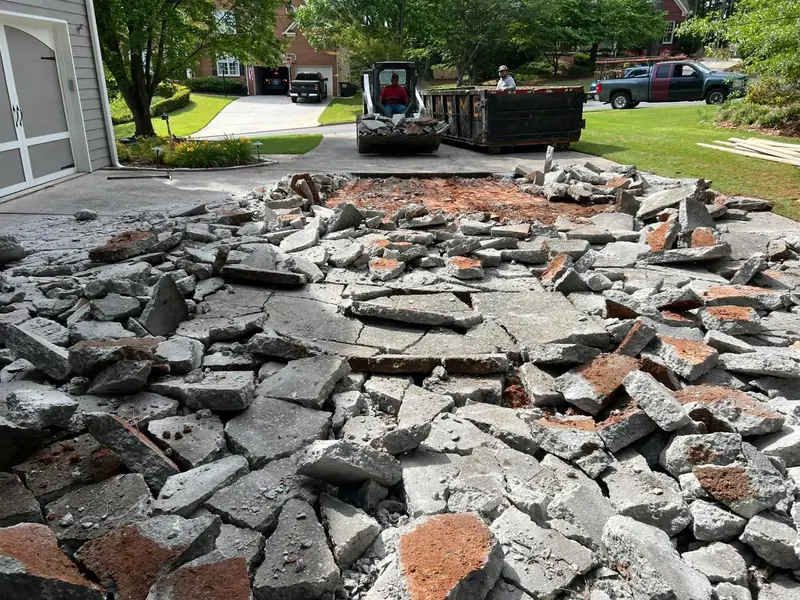
Most replacement jobs start by removing what is already there. Old asphalt or concrete is broken up with an excavator, loaded into a dumpster or truck, and hauled off. Pouring new concrete over a failing surface looks quicker, but the cracks and soft spots underneath tend to work their way up through the new slab.
Grading and base preparation
Once the old drive is gone, the ground is graded so rain runs off the driveway and away from the house and garage, never toward them. On Georgia red clay a compacted gravel base matters. It gives the slab even support and lets water drain out instead of sitting under the concrete. Soft or wet spots are dug out and filled before any forms go in.
Forms, reinforcement and thickness
The forms set the edges, the width and the slope of the finished driveway. A typical residential driveway is poured about four inches thick, and many homeowners go thicker where a heavy truck, camper or trailer will park. Wire mesh or rebar helps hold the slab together if it cracks. We go over thickness and reinforcement for your driveway at the estimate, based on what will actually be driven and parked on it.
Pouring, finishing and control joints
On pour day the concrete is placed, screeded flat and finished. Most driveways get a broom finish, which leaves a fine texture that grips in the rain. Control joints are cut or tooled across the slab at regular spacing. Concrete shrinks as it cures and some cracking is normal, so the joints give it a straight line to crack along instead of a random line across the middle of a panel.
Driveway aprons
The apron is the section between your driveway and the street. It takes the hardest hits, from tires turning onto it and from water running along the curb, so it is often the first piece to break. We can replace just the apron or pour it as part of a new driveway. Your city or HOA may have rules about the apron where it meets the road, so it is worth asking them before the work is scheduled.
Concrete or Asphalt for Your Driveway?
Asphalt usually costs less to put down, but it needs resealing every few years, softens in a Georgia summer and turns gray and brittle as it ages. Concrete costs more up front, stays cooler and lighter in color, and asks for less upkeep over its life. A lot of our driveway jobs are homeowners replacing a tired asphalt drive with concrete for exactly those reasons.
If you want more than plain gray, a driveway can carry a stamped concrete border or a stamped section at the entrance while the main drive stays broom finished. And since the driveway is usually the way into the house, many homeowners have us pour a walkway or front steps at the same time, so the two pieces of concrete match.
What Affects the Cost of a Concrete Driveway
We price every driveway on its own, because the same square footage can be a very different job on two different lots. These are the things that move the number:
- Size and shape. A long curving drive needs more forming and finishing than a short straight one.
- Tear-out. Whether old asphalt or concrete has to be broken out, and how much has to be hauled away.
- Grading and base. Slopes, soft clay, low spots that hold water, and how much gravel the base needs.
- Thickness and reinforcement. A thicker slab with rebar for a work truck or camper uses more material.
- Access. On a long, steep or wooded lot the concrete may need to be pumped or wheeled in.
- Drainage. Some driveways need a channel or a change in grade so water stops running toward the garage. A slope beside the drive sometimes needs a retaining wall to hold it.
- Finish. A broom finish is the standard; stamped or colored sections add to it.
The estimate is free. Francisco measures the driveway, looks at the grade and how water moves across it, and gives you a written number for the whole job, from tear-out to cleanup.
Caring for a New Concrete Driveway
Concrete keeps gaining strength for weeks after it is poured. Keep cars off it for the first several days and heavy trucks off it longer; we will tell you the timing for your pour. In the summer heat a new slab dries fast at the surface, so it is kept damp or covered early on to cure evenly.
After it has cured, a penetrating sealer every few years helps keep water, oil and red clay stains from soaking in. Rinse off fertilizer and pine sap, keep leaves and pine straw out of the joints, and point downspouts away from the slab so water is not running underneath it.
Driveways Across West Metro Atlanta
We are based in Powder Springs and pour driveways for homeowners in Powder Springs, Marietta, Austell, Hiram, Dallas, Douglasville and the towns around them in Cobb, Paulding and Douglas counties. Bigger jobs farther out are worth a call too.
Why Homeowners Call Medina Concrete
- The owner does the estimate. Francisco measures every driveway himself and answers the phone, so you talk to the person responsible for the job.
- Tear-out through cleanup. Removal of the old drive, grading, base, forms, pour and finish, handled as one job.
- A written estimate. You see what is included before you decide, and the estimate is free.
- Se habla español. Call or text in English or Spanish.