
Medina Concrete builds concrete patios in Powder Springs, GA and the surrounding west metro Atlanta towns. That includes a simple broom-finish slab off the back door, a large patio laid out in a grid with river-rock joints, the slab under a raised deck, and the floor of a covered porch. Owner Francisco Medina does every estimate himself and will help you settle on the size and layout before anything is formed.
A patio is mostly about how you will use the space. A table for six, a grill, a fire pit and a path out to the yard all take room, and it is easier to get that right on the ground with a tape measure than on paper. We mark it out with you, look at where the water goes when it rains, and plan the slab around both.
Backyards around here are rarely flat. Many patios sit on a slope, beside a fence line, or against a hill that needs holding back, and those details decide how the job is built.
Patio Styles We Pour
Broom-finish patio slabs
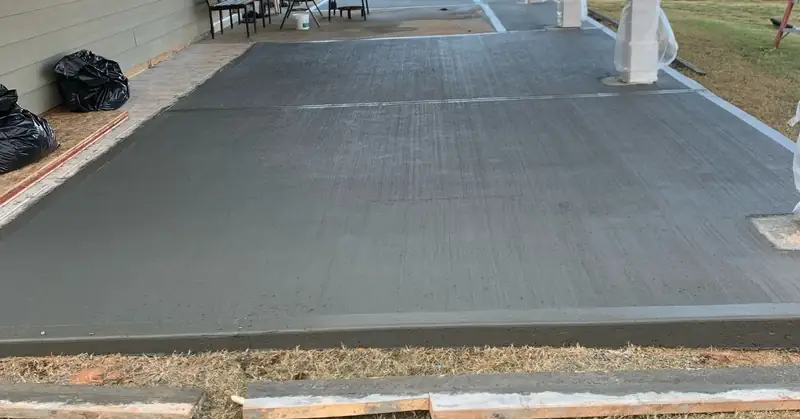
The most common patio is a single slab with a light broom finish. The texture gives you grip when it is wet, the color stays light so it does not hold as much heat as darker surfaces, and it is the simplest surface to keep clean. Control joints are tooled or cut in at regular spacing so normal shrinkage cracks follow a straight line.
Grid patios with rock joints
Instead of one large slab, the patio is formed as a grid of squares with wood forms and poured square by square. The joints between the squares are then filled with black river rock or another gravel. It looks more like a designed hardscape than a slab, lets some rainwater soak in at the joints, and gives the concrete a planned place to move.
Slabs under decks and porches
A lot of our patio work goes under something else. A slab poured under a raised deck turns the bare dirt and weeds underneath into usable, shaded space, and a covered porch needs a solid floor. If you are planning a new deck too, our deck page covers that side of the job.
Decorative patios
If you want the look of stone or slate, a stamped concrete patio is poured the same way and then patterned and colored before it sets. Stain is another option for a richer color under a porch or around a pool.
How a Patio Is Built
A patio that stays flat and drains well starts below the surface. Here is what goes into one:
- Layout and grade. The patio is marked out and the ground is dug and graded so the finished slab falls slightly away from the house. Water should never run back toward your foundation or a door.
- Base. Topsoil and roots come out, soft clay is removed where needed, and a compacted gravel base goes down. A typical patio slab is about four inches of concrete on a few inches of compacted gravel, more where the ground is soft.
- Forms and reinforcement. Forms set the shape and height, and wire mesh or rebar is placed to help hold the slab together.
- Pour and finish. The concrete is placed, screeded, floated and finished to the texture you chose, with joints set as it firms up.
- Curing. In Georgia heat a fresh slab dries fast at the top, so it is kept damp or covered early to cure evenly and avoid surface cracking.
Patios on a Slope
On a sloped yard you have two choices: step the patio down in levels, or build the ground up level and hold it with a wall. We pour patios on top of block walls and next to them, and we build the retaining walls that make a level patio possible on a hillside. Drainage behind the wall matters as much as the wall itself, and we plan both together.
What Affects the Cost of a Concrete Patio
Patios are priced on site, because two patios of the same size can be very different jobs. The main things that change the number are:
- Size and shape, including curves and steps.
- How much digging, grading and base the yard needs, and whether a wall is needed to level it.
- Access. A backyard with no way in for a truck may mean pumping or wheeling the concrete.
- Finish: broom, grid with rock joints, stamped or stained.
- Removal of an old patio, pavers or a rotted deck in the way.
The estimate is free. Francisco looks at the space, talks through how you want to use it, and gives you a written price for the patio you settle on.
Honest Downsides of a Concrete Patio
Concrete is hard underfoot and it will develop some hairline cracks over time, which is why joints matter. Plain gray can look plain, which is what the grid, stamped and stained options are for. Compared with pavers, a cracked section is harder to swap out on its own. For most homeowners, the trade is worth it: a concrete patio is solid, simple to clean and needs little upkeep.
Care is simple. Sweep it, rinse it, keep downspouts pointed away from it, and a penetrating sealer every few years helps keep out grease from the grill and red clay stains.
Patios Across West Metro Atlanta
We pour patios in Powder Springs, Austell, Marietta, Hiram, Dallas, Douglasville and nearby towns in Cobb, Paulding and Douglas counties.
Why Homeowners Call Medina Concrete for a Patio
- The owner lays it out with you. Francisco does every estimate and helps you decide the size and shape on the ground.
- Base and drainage first. Grading, gravel base and slope away from the house come before the pour.
- More than one look. Broom finish, grid with rock joints, stamped or stained.
- Se habla español. Call or text in English or Spanish.