
Medina Concrete handles fence installation in Powder Springs, GA and across west metro Atlanta, mostly wood privacy fences and the gates that go with them. Whether you need to keep a dog in the yard, block the view of a busy road, or close in a backyard you just put a patio in, a privacy fence is usually the answer.
A wood fence is only as straight as its posts, and posts are a concrete job. That is where our main trade helps. Each post goes in a dug hole and is set in concrete, so the fence line stays plumb through wet winters and dry summers on Georgia clay.
Francisco Medina gives every estimate himself. He walks the property line with you, looks at the slope and any trees in the way, and talks through height, style and gate placement before he prices it. Se habla español.
Fence Styles We Install
Most of our fence work is wood privacy fencing. Within that, a few choices change how the fence looks and how it holds up.
Wood privacy fences
A privacy fence uses boards set tight together so you cannot see through it. Six feet is the common height for a backyard. Pressure-treated pine is the usual wood for posts and rails in Georgia, because it stands up to ground moisture far better than untreated lumber.
Board-on-board and shadowbox
Boards can be butted side by side, overlapped on one side, or alternated on both sides of the rail. Overlapping covers the gaps that open up as boards shrink in the summer heat. Alternating boards looks good from both your yard and the neighbor's.
Gates
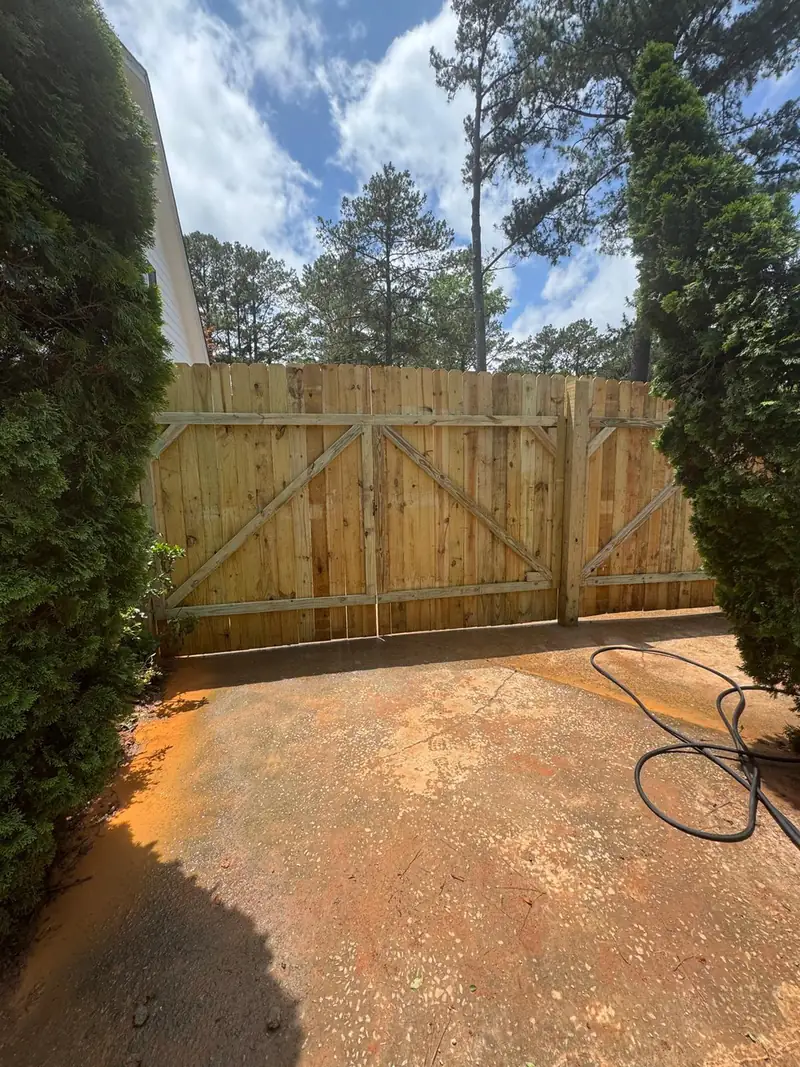
A walk gate for the side yard is the most common. A double gate wide enough for a mower, a trailer or a truck is worth planning in if you will ever need to bring equipment into the backyard. Gates take more stress than any other part of the fence, so the gate posts get extra attention.
Fences on a slope
Few yards in Cobb, Paulding and Douglas counties are flat. On a slope the fence can step down in level sections or follow the grade. Stepping looks tidy but leaves triangles of gap at the bottom; following the grade keeps the bottom tight, which matters if you have a dog.
How a Fence Installation Goes
Marking the line
Before any digging, you need to know where your property line is. A survey or your plat is the place to look. If you are in a neighborhood with an HOA, check its fence rules on height and style before you sign anything. Underground utilities should be marked by calling 811 before digging.
Setting posts in concrete
Post holes are dug deep enough to hold the post firm, and each post is set in concrete and plumbed. The concrete is crowned at the top so rain runs away from the wood instead of collecting around it. This is the step that decides whether the fence is still straight years from now.
Rails, boards and gates
Once the posts have set, the rails go on, then the boards. Gates are hung last, on posts that were set to carry them, and adjusted so they swing and latch cleanly.
Planning the Fence Around Your Yard
A fence lasts a long time, so a few minutes of planning saves years of living with a gate in the wrong place. Think about how you use the yard: where do you carry the trash cans out? Where would a truck back in to deliver mulch or a load of gravel? Which corner floods after a hard rain?
Low spots matter on Georgia clay. A fence run straight across a drainage path can act like a dam if the boards go all the way to the ground, so leave a small gap there or plan for the water. Trees along the line need room for their roots and trunks to grow. Francisco will point out these spots when he walks the line with you.
Caring for a Wood Fence
New pressure-treated wood needs time to dry before it takes a stain or sealer well. After that, a coat every few years keeps the boards from graying and checking in the sun. Keep sprinklers and mulch beds from soaking the bottom of the boards, and trim back vines, which hold moisture against the wood.
What Affects the Cost of a Fence
- Length. Fence is priced along its run, so the total linear footage is the biggest factor.
- Height and style. A taller fence or a board-on-board style uses more lumber.
- Gates. Each gate, and especially a wide double gate, adds hardware and heavier posts.
- Terrain. Slopes, rocky ground, roots and tight spots along a house all slow the digging.
- Old fence removal. Pulling an old fence and its concrete footings is extra work.
The estimate is free. Francisco measures the run, notes the gates and the grade, and gives you a price for the whole fence.
A fence often goes in alongside other yard work. If the yard needs leveling at the fence line, a retaining wall can hold the grade. A new concrete patio or a deck inside the fence finishes the backyard.
Where We Install Fences
We are based in Powder Springs and install fences across west metro Atlanta. See our pages for Austell and Douglasville, and we also work in Marietta, Hiram, Dallas, Mableton, Smyrna and Lithia Springs.
Why Call Medina Concrete for a Fence
- Posts set in concrete. Concrete is our main trade, and the posts are where a fence either stays straight or starts to lean.
- The owner gives the estimate. Francisco Medina walks the line with you himself.
- Free estimates. A price for your fence before you commit to anything.
- Se habla español. Call or text in English or Spanish.