
If you are looking for a deck builder in Powder Springs, GA, Medina Concrete builds wood decks for homes across Cobb, Paulding and Douglas counties. That covers low decks that sit a step or two off the yard, raised decks off a back door, and the stairs that get you down to the ground.
A lot of our deck work comes with concrete attached. Many west metro Atlanta houses sit on a slope, so the back door is a full story above the yard. The space under a raised deck is wasted dirt unless something goes there, and a poured concrete patio turns it into a shaded spot for a grill, a table or storage. Because concrete is most of what we do, we can plan the deck and the slab under it as one project.
Francisco Medina gives every estimate himself. He comes out, looks at the house and the ground, and talks through what you want the deck for before he puts a number on it. Se habla español.
Types of Decks We Build
Most deck projects fall into one of a few shapes. Knowing which one you have makes the estimate conversation faster.
Ground-level and low decks
A low deck sits close to the yard, often with one step down or none. It works well on flatter lots and in spots where a patio would collect water. Built-in benches along the edge save you from buying outdoor furniture and keep the deck open in the middle. Low decks need good airflow and drainage underneath, because wood that sits close to wet Georgia clay stays damp longer.
Raised decks off the back of the house
On a sloped lot the deck often lands at the main floor, eight or more feet above grade. These decks depend on the ledger connection to the house, the footings under each post, and the bracing between posts. Those are the parts you stop seeing once the deck is finished, and they are where we spend the most time on the estimate.
Deck stairs and landings
Stairs are where a deck either feels easy or feels like a ladder. The rise and run of each step, the width, the handrail and where the bottom step lands all matter. A long run of stairs on a tall deck sometimes needs a landing partway down. At the bottom, a small concrete pad or walkway keeps the last step out of the mud.
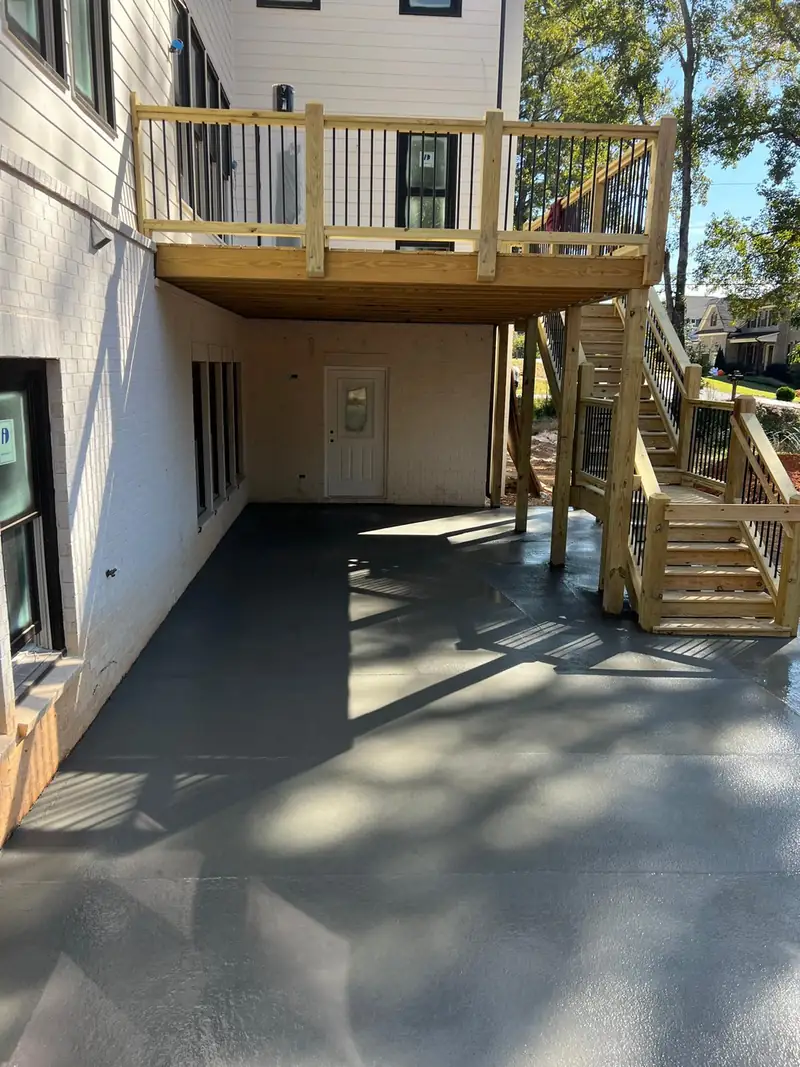
A concrete patio under a raised deck
This is the job we are asked about most. The slab under the deck has to slope away from the house so rain off the deck boards runs out, not toward the foundation. It has to be formed around the deck posts and footings, and it should be poured before or after the deck framing depending on access. Planning both together avoids the common mistake of pouring a slab and then cutting into it for posts.
What Goes Into a Deck That Lasts
The boards on top are what you see. What decides how the deck holds up is mostly underneath.
Footings in Georgia red clay
Every post sits on a concrete footing. Red clay holds water after a heavy rain and shrinks when it dries out in August, so the footing has to go down into firm soil, not just past the topsoil. Georgia's freeze and thaw is mild compared to up north, but it does happen a few times most winters, and footings set too shallow can shift over the years.
The ledger and the house
When a deck attaches to the house, the ledger board carries half the load. It needs to be fastened into the house framing properly and flashed so water does not get behind it and rot the rim of the house. A deck that is pulling away from the house almost always has a ledger problem.
Framing, spacing and boards
Joist spacing, beam size and post spacing depend on how big the deck is and how far each piece spans. Board choice changes how the deck looks and how much care it needs. We talk through the options on site rather than pushing one product.
Caring for a wood deck
Wood decks in Georgia take a beating from summer sun and long wet spells. A good cleaning and a fresh coat of sealer or stain every couple of years, keeping leaves swept off, and keeping gutters from dumping onto the boards will add years to any deck.
What Affects the Cost of a Deck
People ask what a deck costs before anything else, and the honest answer is that it depends on a handful of things you can see on your own lot:
- Size and height. A tall deck needs longer posts, more bracing and usually more stairs than a low one with the same footprint.
- The slope and soil. A steep yard or soft clay means more digging and deeper footings.
- Stairs, railings and benches. Each adds material and labor. Railing runs add up fast on a raised deck.
- Board choice. Different decking costs different amounts and needs different care.
- Concrete underneath. Adding a patio under the deck is extra work, but doing it at the same time costs less than coming back later.
- Old deck removal. Tearing out and hauling away an old deck is part of the job if there is one.
The free estimate is where those turn into a real number for your house. Francisco measures, looks at the grade and the connection to the house, and walks you through the price.
Want stone or a pattern on the ground below instead of plain concrete? Take a look at our stamped concrete options, or read more about plain concrete patios. If you want shade on the ground instead of a deck in the air, a pergola or pavilion over a slab may be the better fit.
Where We Build Decks
We are based in Powder Springs and build decks across west metro Atlanta. See our pages for Powder Springs and Marietta, and we also work in Austell, Hiram, Dallas, Douglasville, Mableton, Smyrna and Kennesaw. For a bigger project, Francisco will travel farther.
Why Homeowners Call Medina Concrete for a Deck
- The deck and the slab in one plan. Concrete is our main trade, so the patio under a raised deck is part of the same project, not a second contractor.
- The owner gives the estimate. Francisco Medina looks at every job himself and answers his own phone.
- Free estimates. You get a price for your deck on your lot before you commit to anything.
- Se habla español. Call or text in English or Spanish.