
Pergolas give a backyard shade and a sense of being a room without closing it in. Medina Concrete builds wood pergolas and timber pavilions for homes in Powder Springs and across west metro Atlanta, and because concrete is our main trade, we can pour the slab they stand on as part of the same job.
That matters more than it sounds. A pergola set on an old patio that was never meant to carry posts, or on bare ground that turns to red mud after every storm, is a pergola nobody uses. Starting with the right slab, sloped for drainage and thickened where the posts land, gives you a covered spot that works year round.
Francisco Medina gives every estimate himself. He looks at the yard, where the sun hits in the afternoon, and how water moves across the lot before he suggests a size or a shape. Se habla español.
Pergola or Pavilion: Which One Do You Need?
People use the words loosely, so it helps to start with what each one does.
Pergolas
A pergola is a frame of posts and beams with open rafters or slats on top. It breaks up the sun rather than blocking it, and it does not keep rain off. Many people grow vines over one or add a shade cloth later. A pergola is the lighter, more open choice, and it suits a patio off the back door or a spot at the edge of the yard.
Timber pavilions
A pavilion has a solid roof on a heavier timber frame, often with trusses you can see from below. It keeps you dry, so it works for an outdoor kitchen, a dining table or a place to sit out a summer storm. Because a roof catches wind and carries weight, a pavilion needs bigger posts, stronger connections and footings sized for it.
Pergolas over a deck
A pergola can also go on top of a deck, but the posts then need to carry down through the deck framing to footings in the ground. If you are planning a new deck, it is far easier to plan the pergola posts into it from the start.
Starting From the Ground: The Slab Under a Pergola
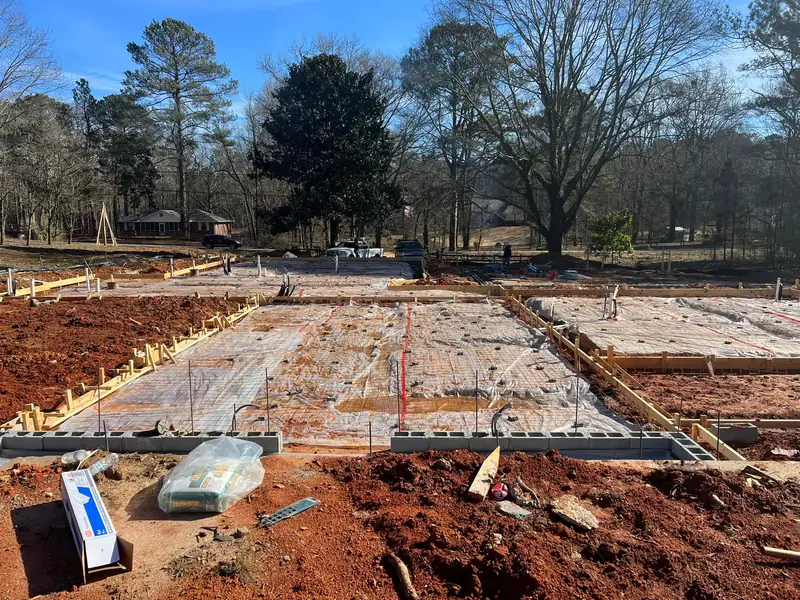
The concrete under a pergola or pavilion is our side of the trade, and it is the part most likely to go wrong when it is an afterthought.
Base prep on Georgia clay
Red clay swells when it is wet and shrinks when it dries. We strip the topsoil, compact the base and add gravel where it is needed, so the slab does not settle unevenly under one post.
Footings and post bases
Each post needs something solid under it. Depending on the design, that is a separate footing below the slab or a thickened section of the slab itself, with a post base set so the wood never sits in standing water.
Slope and drainage
A slab under a pergola gets rain straight through the top. Under a pavilion, the roof sends water off the edges. Either way the slab should fall gently away from the house, and a heavy Georgia downpour should have somewhere to go.
Finish choices
A broom finish is the plain, non-slip choice. If you want the floor to look like stone or slate, stamped concrete pairs well with a timber frame. Our concrete patios page covers finishes, thickness and joints in more detail.
Design Choices That Change the Feel
- Size and height. A frame that is too low feels cramped under a ceiling fan; one that is too tall lets the sun in under the edges.
- Rafter spacing. Tighter rafters or slats give more shade. Wider spacing looks lighter.
- Orientation. Which way the rafters run against the afternoon sun changes how much shade you get at the time you actually sit outside.
- Attached or freestanding. Attaching to the house saves posts but ties the frame into your roofline and siding. A freestanding frame can go anywhere in the yard.
- Open or roofed. The biggest choice, and the one that decides between a pergola and a pavilion.
What Affects the Price of a Pergola
The size of the frame, whether it has a roof, the size of the timbers and the number of posts drive most of the cost. The slab adds its own line: how big it is, how much grading the spot needs, and whether you want a plain or decorative finish. Removing an old patio or deck is extra work if there is one. Building it yourself from a kit can look cheaper, but a kit still needs a proper base and footings, which is where a lot of the real work is.
The estimate is free. Francisco comes out, measures the spot, and prices the frame and the slab together so you see the whole project.
Where We Build Pergolas
We are based in Powder Springs and work across Cobb, Paulding and Douglas counties. See our pages for Powder Springs and Hiram, and we also build in Marietta, Austell, Dallas, Douglasville and nearby towns.
Why Call Medina Concrete for a Pergola
- The frame and the floor together. One contractor plans the slab, the footings and the pergola, so the posts land where the concrete is ready for them.
- The owner gives the estimate. Francisco Medina looks at every job himself.
- Free estimates. A price for your pergola on your lot before you commit.
- Se habla español. Call or text in English or Spanish.